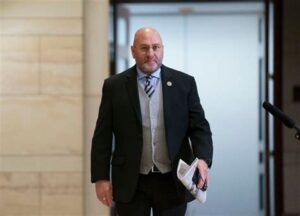
Statesman, Clay Higgins of Louisiana,
Question:
If H.R. 5693 passes, state racing commissions are no longer legally obligated to be regulated by HISA, or by RHSO (Racehorse Health and Safety Organization); so what stops state racing commissions from just remaining independent as they did before the Interstate Horseracing Act of 1978?
Statesman, Higgins,
Question:
If H.R. 5693 repeals The Horseracing Integrity and Safety Act of 2020 (15 U.S.C. 3051 et seq.), which incentives do state racing commissions have in order to enter into an(y) interstate compact in accordance with your proposed bill?
In other words, if state commissions are not legally compelled to be regulated by HISA, what stops state racing commissions from just remaining independent as they did before the Interstate Horseracing Act of 1978?
If H.R. 5693 passes, state racing commissions are no longer legally obligated to be regulated by HISA. They, (state racing commissions and other entities,), furthermore, have not voted to be overseen by RHSO (Racehorse Health and Safety Organization). Therefore, what induces state racing commissions to acquiesce to H.R. 5693, instead of remaining judiciously and financially independent of/from RHSO oversight?
The Federal Trade Commission (FTC), indeed, oversees the gambling aspect of horseracing on the federal, state and county levels. However, proponents of the Horseracing Integrity and Safety Act of 2020 (HISA,) vowed for, or are/and/(were,) a private entity, labeling themselves as a federal, “Authority”.
SEE: 18 USC Ch. 43 FALSE PERSONATION: sec. 912 and 913 : “Whoever falsely assumes or pretends to be an officer or employee acting under the authority of the United States or any department, agency or officer thereof, and acts as such, or in such pretended character demands or obtains any money, paper, document, or thing of value, shall be fined under this title or imprisoned not more than three years, or both.” …
“Whoever falsely represents himself to be an officer, agent, or employee of the United States, and in such assumed character arrests or detains any person or in any manner searches the person, buildings, or other property of any person, shall be fined under this title or imprisoned not more than three years, or both …”
Under the above, indicated, unconstitutional guise, (see the non-delegation doctrine), the Horseracing Integrity and Safety Authority did, in fact, (in conflict with section 32), interfere with the Federal Trade Commission’s ability to enforce federal law.