

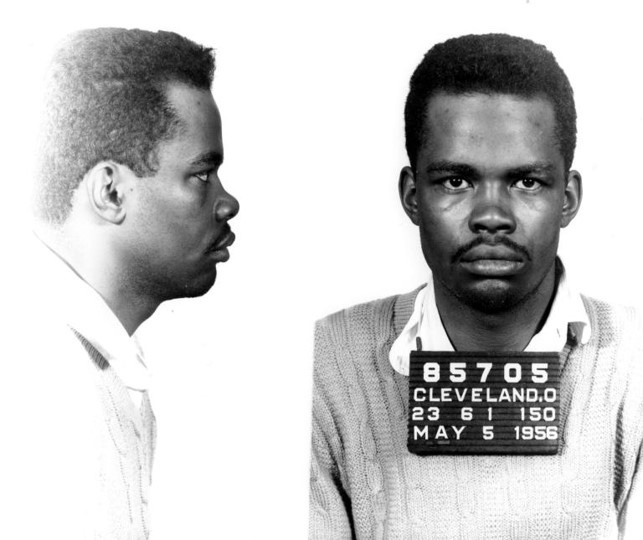
TERRY v. OHIO
No. 67
SUPREME COURT OF THE UNITED STATES
392 U.S. 1; 88 S. Ct. 1868
December 12, 1967, Argued
June 10, 1968, Decided
SYLLABUS
A Cleveland detective (McFadden), on a downtown beat which he had been patrolling for many years, observed
two strangers (petitioner and another man, Chilton) on a street corner. He saw them proceed alternately back and forth
along an identical route, pausing to stare in the same store window, which they did for a total of about 24 times. Each
completion of the route was followed by a conference between the two on a corner, at one of which they were joined by
a third man (Katz) who left swiftly. Suspecting the two men of “casing a job, a stick-up,” the officer followed them
and saw them rejoin the third man a couple of blocks away in front of a store. The officer approached the three, identi-
fied himself as a policeman, and asked their names. The men “mumbled something,” whereupon McFadden spun peti-
tioner around, patted down his outside clothing, and found in his overcoat pocket, but was unable to remove, a pistol.
The officer ordered the three into the store. He removed petitioner’s overcoat, took out a revolver, and ordered the
three to face the wall with their hands raised. He patted down the outer clothing of Chilton and Katz and seized a re-
volver from Chilton’s outside overcoat pocket. He did not put his hands under the outer garments of Katz (since he
discovered nothing in his pat-down which might have been a weapon), or under petitioner’s or Chilton’s outer garments
until he felt the guns. The three were taken to the police station. Petitioner and Chilton were charged with carrying
concealed weapons. The defense moved to suppress the weapons. Though the trial court rejected the prosecution theory
that the guns had been seized during a search incident to a lawful arrest, the court denied the motion to suppress and
admitted the weapons into evidence on the ground that the officer had cause to believe that petitioner and Chilton were
acting suspiciously, that their interrogation was warranted, and that the officer for his own protection had the right to pat
down their outer clothing having reasonable cause to believe that they might be armed. The court distinguished between
an investigatory “stop” and an arrest, and between a “frisk” of the outer clothing for weapons and a full-blown search
for evidence of crime. Petitioner and Chilton were found guilty, an intermediate appellate court affirmed, and the State
Supreme Court dismissed the appeal on the ground that “no substantial constitutional question” was involved. Held:
1. The Fourth Amendment right against unreasonable searches and seizures, made applicable to the States by the
Fourteenth Amendment, “protects people, not places,” and therefore applies as much to the citizen on the streets as well
as at home or elsewhere. Pp. 8-9.
2. The issue in this case is not the abstract propriety of the police conduct but the admissibility against petitioner of
the evidence uncovered by the search and seizure. P. 12.
3. The exclusionary rule cannot properly be invoked to exclude the products of legitimate and restrained police in-
vestigative techniques; and this Court’s approval of such techniques should not discourage remedies other than the ex-
clusionary rule to curtail police abuses for which that is not an effective sanction. Pp. 13-15.
4. The Fourth Amendment applies to “stop and frisk” procedures such as those followed here. Pp. 16-20.
(a) Whenever a police officer accosts an individual and restrains his freedom to walk away, he has “seized” that
person within the meaning of the Fourth Amendment. P. 16.
(b) A careful exploration of the outer surfaces of a person’s clothing in an attempt to find weapons is a “search” un-
der that Amendment. P. 16.
5. Where a reasonably prudent officer is warranted in the circumstances of a given case in believing that his safety
or that of others is endangered, he may make a reasonable search for weapons of the person believed by him to be
armed and dangerous regardless of whether he has probable cause to arrest that individual for crime or the absolute cer-
tainty that the individual is armed. Pp. 20-27.
1(a) Though the police must whenever practicable secure a warrant to make a search and seizure, that procedure
cannot be followed where swift action based upon on-the-spot observations of the officer on the beat is required. P. 20.
(b) The reasonableness of any particular search and seizure must be assessed in light of the particular circumstances
against the standard of whether a man of reasonable caution is warranted in believing that the action taken was appro-
priate. Pp. 21-22.
(c) The officer here was performing a legitimate function of investigating suspicious conduct when he decided to
approach petitioner and his companions. P. 22.
(d) An officer justified in believing that an individual whose suspicious behavior he is investigating at close range
is armed may, to neutralize the threat of physical harm, take necessary measures to determine whether that person is
carrying a weapon. P. 24.
(e) A search for weapons in the absence of probable cause to arrest must be strictly circumscribed by the exigencies
of the situation. Pp. 25-26.
(f) An officer may make an intrusion short of arrest where he has reasonable apprehension of danger before being
possessed of information justifying arrest. Pp. 26-27.
6. The officer’s protective seizure of petitioner and his companions and the limited search which he made were
reasonable, both at their inception and as conducted. Pp. 27-30.
(a) The actions of petitioner and his companions were consistent with the officer’s hypothesis that they were con-
templating a daylight robbery and were armed. P. 28.
(b) The officer’s search was confined to what was minimally necessary to determine whether the men were armed,
and the intrusion, which was made for the sole purpose of protecting himself and others nearby, was confined to as-
certaining the presence of weapons. Pp. 29-30.
7. The revolver seized from petitioner was properly admitted into evidence against him, since the search which led
to its seizure was reasonable under the Fourth Amendment. Pp. 30-31.
COUNSEL: Louis Stokes argued the cause for petitioner. With him on the brief was Jack G. Day.
Reuben M. Payne argued the cause for respondent. With him on the brief was John T. Corrigan.
Briefs of amici curiae, urging reversal, were filed by Jack Greenberg, James M. Nabrit III, Michael Meltsner, Melvyn
Zarr, and Anthony G. Amsterdam for the NAACP Legal Defense and Educational Fund, Inc., and by Bernard A. Berk-
man, Melvin L. Wulf, and Alan H. Levine for the American Civil Liberties Union et al.
Briefs of amici curiae, urging affirmance, were filed by Solicitor General Griswold, Assistant Attorney General Vinson,
Ralph S. Spritzer, Beatrice Rosenberg, and Mervyn Hamburg for the United States; by Louis J. Lefkowitz, pro se,
Samuel A. Hirshowitz, First Assistant Attorney General, and Maria L. Marcus and Brenda Soloff, Assistant Attorneys
General, for the Attorney General of New York; by Charles Moylan, Jr., Evelle J. Younger, and Harry Wood for the
National District Attorneys’ Assn., and by James R. Thompson for Americans for Effective Law Enforcement.
JUDGES: Warren, Black, Douglas, Harlan, Brennan, Stewart, White, Fortas, Marshall
OPINION BY: WARREN
OPINION
[*4] [**1871] MR. CHIEF JUSTICE WARREN delivered the opinion of the Court.
This case presents serious questions concerning the role of the Fourth Amendment in the confrontation on the street
between the citizen and the policeman investigating suspicious circumstances.
Petitioner Terry was convicted of carrying a concealed weapon and sentenced to the statutorily prescribed term of
one to three years in the penitentiary. 1 Following [*5] the denial of a pretrial motion to suppress, the prosecution
introduced in evidence two revolvers and a number of bullets seized from Terry and a codefendant, Richard Chilton, 2
2by Cleveland Police Detective Martin McFadden. At the hearing on the motion to suppress this evidence, Officer
McFadden testified that while he was patrolling in plain clothes in downtown Cleveland at approximately 2:30 in the
afternoon of October 31, 1963, his attention was attracted by two men, Chilton and Terry, standing on the corner of
Huron Road and Euclid Avenue. He had never seen the two men before, and he was unable to say precisely what first
drew his eye to them. However, he testified that he had been a policeman for 39 years and a detective for 35 and that
he had been assigned to patrol this vicinity of downtown Cleveland for shoplifters and pickpockets for 30 years. He
explained that he had developed routine habits of observation over the years and that he would “stand and watch people
or walk and watch people at many intervals of the day.” He added: “Now, in this case when I looked over they didn’t
look right to me at the time.”
1 Ohio Rev. Code § 2923.01 (1953) provides in part that “no person shall carry a pistol, bowie knife, dirk, or
other dangerous weapon concealed on or about his person.” An exception is made for properly authorized law
enforcement officers.
2 Terry and Chilton were arrested, indicted, tried, and convicted together. They were represented by the
same attorney, and they made a joint motion to suppress the guns. After the motion was denied, evidence was
taken in the case against Chilton. This evidence consisted of the testimony of the arresting officer and of Chil-
ton. It was then stipulated that this testimony would be applied to the case against Terry, and no further evi-
dence was introduced in that case. The trial judge considered the two cases together, rendered the decisions at
the same time and sentenced the two men at the same time. They prosecuted their state court appeals together
through the same attorney, and they petitioned this Court for certiorari together. Following the grant of the writ
upon this joint petition, Chilton died. Thus, only Terry’s conviction is here for review.
His interest aroused, Officer McFadden took up a post of observation in the [**1872] entrance to a store 300 to
400 feet [*6] away from the two men. “I get more purpose to watch them when I seen their movements,” he testi-
fied. He saw one of the men leave the other one and walk southwest on Huron Road, past some stores. The man
paused for a moment and looked in a store window, then walked on a short distance, turned around and walked back
toward the corner, pausing once again to look in the same store window. He rejoined his companion at the corner, and
the two conferred briefly. Then the second man went through the same series of motions, strolling down Huron Road,
looking in the same window, walking on a short distance, turning back, peering in the store window again, and returning
to confer with the first man at the corner. The two men repeated this ritual alternately between five and six times
apiece — in all, roughly a dozen trips. At one point, while the two were standing together on the corner, a third man
approached them and engaged them briefly in conversation. This man then left the two others and walked west on Eu-
clid Avenue. Chilton and Terry resumed their measured pacing, peering, and conferring. After this had gone on for
10 to 12 minutes, the two men walked off together, heading west on Euclid Avenue, following the path taken earlier by
the third man.
By this time Officer McFadden had become thoroughly suspicious. He testified that after observing their elabo-
rately casual and oft-repeated reconnaissance of the store window on Huron Road, he suspected the two men of “casing
a job, a stick-up,” and that he considered it his duty as a police officer to investigate further. He added that he feared
“they may have a gun.” Thus, Officer McFadden followed Chilton and Terry and saw them stop in front of Zucker’s
store to talk to the same man who had conferred with them earlier on the street corner. Deciding that the situation was
ripe for direct action, Officer McFadden approached the three men, identified [*7] himself as a police officer and
asked for their names. At this point his knowledge was confined to what he had observed. He was not acquainted
with any of the three men by name or by sight, and he had received no information concerning them from any other
source. When the men “mumbled something” in response to his inquiries, Officer McFadden grabbed petitioner Terry,
spun him around so that they were facing the other two, with Terry between McFadden and the others, and patted down
the outside of his clothing. In the left breast pocket of Terry’s overcoat Officer McFadden felt a pistol. He reached in-
side the overcoat pocket, but was unable to remove the gun. At this point, keeping Terry between himself and the oth-
ers, the officer ordered all three men to enter Zucker’s store. As they went in, he removed Terry’s overcoat completely,
removed a .38-caliber revolver from the pocket and ordered all three men to face the wall with their hands raised. Of-
ficer McFadden proceeded to pat down the outer clothing of Chilton and the third man, Katz. He discovered another
revolver in the outer pocket of Chilton’s overcoat, but no weapons were found on Katz. The officer testified that he
only patted the men down to see whether they had weapons, and that he did not put his hands beneath the outer gar-
ments of either Terry or Chilton until he felt their guns. So far as appears from the record, he never placed his hands
beneath Katz’ outer garments. Officer McFadden seized Chilton’s gun, asked the proprietor of the store to call a police
3wagon, and took all three men to the station, where Chilton and Terry were formally charged with carrying concealed
weapons.
On the motion to suppress the guns the prosecution took the position that they had been seized following a search
incident to a lawful arrest. The trial court rejected this theory, stating that it “would be stretching the facts beyond rea-
sonable comprehension” to find that Officer [*8] McFadden had had probable [**1873] cause to arrest the men
before he patted them down for weapons. However, the court denied the defendants’ motion on the ground that Officer
McFadden, on the basis of his experience, “had reasonable cause to believe . . . that the defendants were conducting
themselves suspiciously, and some interrogation should be made of their action.” Purely for his own protection, the
court held, the officer had the right to pat down the outer clothing of these men, who he had reasonable cause to believe
might be armed. The court distinguished between an investigatory “stop” and an arrest, and between a “frisk” of the
outer clothing for weapons and a full-blown search for evidence of crime. The frisk, it held, was essential to the proper
performance of the officer’s investigatory duties, for without it “the answer to the police officer may be a bullet, and a
loaded pistol discovered during the frisk is admissible.”
After the court denied their motion to suppress, Chilton and Terry waived jury trial and pleaded not guilty. The
court adjudged them guilty, and the Court of Appeals for the Eighth Judicial District, Cuyahoga County, affirmed.
State v. Terry, 5 Ohio App. 2d 122, 214 N. E. 2d 114 (1966). The Supreme Court of Ohio dismissed their appeal on the
ground that no “substantial constitutional question” was involved. We granted certiorari, 387 U.S. 929 (1967), to de-
termine whether the admission of the revolvers in evidence violated petitioner’s rights under the Fourth Amendment,
made applicable to the States by the Fourteenth. Mapp v. Ohio, 367 U.S. 643 (1961). We affirm the conviction.
I.
The Fourth Amendment provides that “the right of the people to be secure in their persons, houses, papers, and ef-
fects, against unreasonable searches and seizures, shall not be violated . . . .” This inestimable right of [*9] personal
security belongs as much to the citizen on the streets of our cities as to the homeowner closeted in his study to dispose
of his secret affairs. For, as this Court has always recognized,
“No right is held more sacred, or is more carefully guarded, by the common law, than the right of every individual
to the possession and control of his own person, free from all restraint or interference of others, unless by clear and un-
questionable authority of law.” Union Pac. R. Co. v. Botsford, 141 U.S. 250, 251 (1891). We have recently held that
“the Fourth Amendment protects people, not places,” Katz v. United States, 389 U.S. 347, 351 (1967), and wherever an
individual may harbor a reasonable “expectation of privacy,” id., at 361 (MR. JUSTICE HARLAN, concurring), he is
entitled to be free from unreasonable governmental intrusion. Of course, the specific content and incidents of this right
must be shaped by the context in which it is asserted. For “what the Constitution forbids is not all searches and sei-
zures, but unreasonable searches and seizures.” Elkins v. United States, 364 U.S. 206, 222 (1960). Unquestionably
petitioner was entitled to the protection of the Fourth Amendment as he walked down the street in Cleveland. Beck v.
Ohio, 379 U.S. 89 (1964); Rios v. United States, 364 U.S. 253 (1960); Henry v. United States, 361 U.S. 98 (1959);
United States v. Di Re, 332 U.S. 581 (1948); Carroll v. United States, 267 U.S. 132 (1925). The question is whether in
all the circumstances of this on-the-street encounter, his right to personal security was violated by an unreasonable
search and seizure.
[**1874] We would be less than candid if we did not acknowledge that this question thrusts to the fore difficult
and troublesome issues regarding a sensitive area of police activity — issues which have never before been squarely
[*10] presented to this Court. Reflective of the tensions involved are the practical and constitutional arguments
pressed with great vigor on both sides of the public debate over the power of the police to “stop and frisk” — as it is
sometimes euphemistically termed — suspicious persons.
On the one hand, it is frequently argued that in dealing with the rapidly unfolding and often dangerous situations on
city streets the police are in need of an escalating set of flexible responses, graduated in relation to the amount of infor-
mation they possess. For this purpose it is urged that distinctions should be made between a “stop” and an “arrest” (or a
“seizure” of a person), and between a “frisk” and a “search.” 3 Thus, it is argued, the police should be allowed to “stop” a
person and detain him briefly for questioning upon suspicion that he may be connected with criminal activity. Upon
suspicion that the person may be armed, the police should have the power to “frisk” him for weapons. If the “stop” and
the “frisk” give rise to probable cause to believe that the suspect has committed a crime, then the police should be em-
powered to make a formal “arrest,” and a full incident “search” of the person. This scheme is justified in part upon the
notion that a “stop” and a “frisk” amount to a mere “minor inconvenience and petty indignity,” 4 which can properly be
4imposed upon the [*11] citizen in the interest of effective law enforcement on the basis of a police officer’s suspicion.
5
3 Both the trial court and the Ohio Court of Appeals in this case relied upon such a distinction. State v. Ter-
ry, 5 Ohio App. 2d 122, 125-130, 214 N. E. 2d 114, 117-120 (1966). See also, e. g., People v. Rivera, 14 N. Y.
2d 441, 201 N. E. 2d 32, 252 N. Y. S. 2d 458 (1964), cert. denied, 379 U.S. 978 (1965); Aspen, Arrest and Ar-
rest Alternatives: Recent Trends, 1966 U. Ill. L. F. 241, 249-254; Warner, The Uniform Arrest Act, 28 Va. L.
Rev. 315 (1942); Note, Stop and Frisk in California, 18 Hastings L. J. 623, 629-632 (1967).
4 People v. Rivera, supra, n. 3, at 447, 201 N. E. 2d, at 36, 252 N. Y. S. 2d, at 464.
5 The theory is well laid out in the Rivera opinion:
“The evidence needed to make the inquiry is not of the same degree of conclusiveness as that required for
an arrest. The stopping of the individual to inquire is not an arrest and the ground upon which the police may
make the inquiry may be less incriminating than the ground for an arrest for a crime known to have been com-
mitted. . . .
. . . .
“And as the right to stop and inquire is to be justified for a cause less conclusive than that which would sus-
tain an arrest, so the right to frisk may be justified as an incident to inquiry upon grounds of elemental safety and
precaution which might not initially sustain a search. Ultimately the validity of the frisk narrows down to
whether there is or is not a right by the police to touch the person questioned. The sense of exterior touch here
involved is not very far different from the sense of sight or hearing — senses upon which police customarily act.”
People v. Rivera, 14 N. Y. 2d 441, 445, 447, 201 N. E. 2d 32, 34, 35, 252 N. Y. S. 2d 458, 461, 463 (1964), cert.
denied, 379 U.S. 978 (1965).
On the other side the argument is made that the authority of the police must be strictly circumscribed by the law of
arrest and search as it has developed to date in the traditional jurisprudence of the Fourth Amendment.
6 It is contended
with some force that there is not — and cannot be — a variety of police activity which does not depend solely upon the
voluntary cooperation of the citizen and yet which stops short of an arrest based upon probable cause to make such an
arrest. The heart of the Fourth Amendment, the argument [**1875] runs, is a severe requirement of specific justifica-
tion for any intrusion upon protected personal security, coupled with a highly developed system of judicial controls to
enforce upon the agents of the State the commands of the Constitution. Acquiescence by the courts in the compulsion
inherent [*12] in the field interrogation practices at issue here, it is urged, would constitute an abdication of judicial
control over, and indeed an encouragement of, substantial interference with liberty and personal security by police of-
ficers whose judgment is necessarily colored by their primary involvement in “the often competitive enterprise of fer-
reting out crime.” Johnson v. United States, 333 U.S. 10, 14 (1948). This, it is argued, can only serve to exacerbate
police-community tensions in the crowded centers of our Nation’s cities. 7
6 See, e. g., Foote, The Fourth Amendment: Obstacle or Necessity in the Law of Arrest?, 51 J. Crim. L. C. &
P. S. 402 (1960).
7 See n. 11, infra.
In this context we approach the issues in this case mindful of the limitations of the judicial function in controlling
the myriad daily situations in which policemen and citizens confront each other on the street. The State has character-
ized the issue here as “the right of a police officer . . . to make an on-the-street stop, interrogate and pat down for weap-
ons (known in street vernacular as ‘stop and frisk’). ” 8 But this is only partly accurate. For the issue is not the abstract
propriety of the police conduct, but the admissibility against petitioner of the evidence uncovered by the search and sei-
zure. Ever since its inception, the rule excluding evidence seized in violation of the Fourth Amendment has been recog-
nized as a principal mode of discouraging lawless police conduct. See Weeks v. United States, 232 U.S. 383, 391-393
(1914). Thus its major thrust is a deterrent one, see Linkletter v. Walker, 381 U.S. 618, 629-635 (1965), and experience
has taught that it is the only effective deterrent to police misconduct in the criminal context, and that without it the con-
stitutional guarantee against unreasonable searches and seizures would be a mere “form of words.” Mapp v. Ohio, 367
U.S. 643, 655 (1961). The rule also serves another vital function — “the imperative of judicial integrity.” Elkins [*13]
v. United States, 364 U.S. 206, 222 (1960). Courts which sit under our Constitution cannot and will not be made party to
lawless invasions of the constitutional rights of citizens by permitting unhindered governmental use of the fruits of such
invasions. Thus in our system evidentiary rulings provide the context in which the judicial process of inclusion and ex-
clusion approves some conduct as comporting with constitutional guarantees and disapproves other actions by state
5agents. A ruling admitting evidence in a criminal trial, we recognize, has the necessary effect of legitimizing the con-
duct which produced the evidence, while an application of the exclusionary rule withholds the constitutional imprima-
tur.
8 Brief for Respondent 2.
The exclusionary rule has its limitations, however, as a tool of judicial control. It cannot properly be invoked to
exclude the products of legitimate police investigative techniques on the ground that much conduct which is closely
similar involves unwarranted intrusions upon constitutional protections. Moreover, in some contexts the rule is inef-
fective as a deterrent. Street encounters between citizens and police officers are incredibly rich in diversity. They
range from wholly friendly exchanges of pleasantries or mutually useful information to hostile confrontations of armed
men involving arrests, or injuries, or loss of life. Moreover, hostile confrontations are not all of a piece. Some of
them begin in a friendly enough manner, only to take a [**1876] different turn upon the injection of some unex-
pected element into the conversation. Encounters are initiated by the police for a wide variety of purposes, some of
which are wholly unrelated to a desire to prosecute for crime. 9 Doubtless some [*14] police “field interrogation”
conduct violates the Fourth Amendment. But a stern refusal by this Court to condone such activity does not necessarily
render it responsive to the exclusionary rule. Regardless of how effective the rule may be where obtaining convictions is
an important objective of the police, 10 it is powerless to deter invasions of constitutionally guaranteed rights where the
police either have no interest in prosecuting or are willing to forgo successful prosecution in the interest of serving some
other goal.
9 See L. Tiffany, D. McIntyre & D. Rotenberg, Detection of Crime: Stopping and Questioning, Search and
Seizure, Encouragement and Entrapment 18-56 (1967). This sort of police conduct may, for example, be de-
signed simply to help an intoxicated person find his way home, with no intention of arresting him unless he be-
comes obstreperous. Or the police may be seeking to mediate a domestic quarrel which threatens to erupt into
violence. They may accost a woman in an area known for prostitution as part of a harassment campaign de-
signed to drive prostitutes away without the considerable difficulty involved in prosecuting them. Or they may
be conducting a dragnet search of all teenagers in a particular section of the city for weapons because they have
heard rumors of an impending gang fight.
10 See Tiffany, McIntyre & Rotenberg, supra, n. 9, at 100-101; Comment, 47 Nw. U. L. Rev. 493, 497-499
(1952).
Proper adjudication of cases in which the exclusionary rule is invoked demands a constant awareness of these limi-
tations. The wholesale harassment by certain elements of the police community, of which minority groups, particularly
Negroes, frequently complain, 11 will not be [*15] stopped by the exclusion of any evidence from any criminal trial.
Yet a rigid and unthinking application of the exclusionary rule, in futile protest against practices which it can never be
used effectively to control, may exact a high toll in human injury and frustration of efforts to prevent crime. No judi-
cial opinion can comprehend the protean variety of the street encounter, and we can only judge the facts of the case be-
fore us. Nothing we say today is to be taken as indicating approval of police conduct outside the legitimate investiga-
tive sphere. Under our decision, courts still retain their traditional responsibility to guard against police conduct which
is overbearing or harassing, or which trenches upon personal security without the objective evidentiary justification
which the Constitution requires. When such conduct is identified, it must be condemned by the judiciary and its fruits
must be excluded from evidence in criminal trials. And, of course, our approval of legitimate and restrained investiga-
tive conduct undertaken [**1877] on the basis of ample factual justification should in no way discourage the em-
ployment of other remedies than the exclusionary rule to curtail abuses for which that sanction may prove inappropriate.
11 The President’s Commission on Law Enforcement and Administration of Justice found that “in many
communities, field interrogations are a major source of friction between the police and minority groups.” Presi-
dent’s Commission on Law Enforcement and Administration of Justice, Task Force Report: The Police 183
(1967). It was reported that the friction caused by “misuse of field interrogations” increases “as more police
departments adopt ‘aggressive patrol’ in which officers are encouraged routinely to stop and question persons on
the street who are unknown to them, who are suspicious, or whose purpose for being abroad is not readily evi-
dent.” Id., at 184. While the frequency with which “frisking” forms a part of field interrogation practice varies
tremendously with the locale, the objective of the interrogation, and the particular officer, see Tiffany, McIntyre
& Rotenberg, supra, n. 9, at 47-48, it cannot help but be a severely exacerbating factor in police-community ten-
sions. This is particularly true in situations where the “stop and frisk” of youths or minority group members is
6″motivated by the officers’ perceived need to maintain the power image of the beat officer, an aim sometimes
accomplished by humiliating anyone who attempts to undermine police control of the streets.” Ibid.
Having thus roughly sketched the perimeters of the constitutional debate over the limits on police investigative
conduct in general and the background against which this case presents itself, we turn our attention to the quite narrow
question posed by the facts before us: whether it is always unreasonable for a policeman to seize a person and subject
him to a limited search for weapons unless there is probable cause for an arrest. [*16] Given the narrowness of this
question, we have no occasion to canvass in detail the constitutional limitations upon the scope of a policeman’s power
when he confronts a citizen without probable cause to arrest him.
II.
Our first task is to establish at what point in this encounter the Fourth Amendment becomes relevant. That is, we
must decide whether and when Officer McFadden “seized” Terry and whether and when he conducted a “search.” There
is some suggestion in the use of such terms as “stop” and “frisk” that such police conduct is outside the purview of the
Fourth Amendment because neither action rises to the level of a “search” or “seizure” within the meaning of the Consti-
tution. 12 We emphatically reject this notion. It is quite plain that the Fourth Amendment governs “seizures” of the per-
son which do not eventuate in a trip to the station house and prosecution for crime — “arrests” in traditional terminology.
It must be recognized that whenever a police officer accosts an individual and restrains his freedom to walk away, he has “seized” that person. And it is nothing less than sheer torture of the English language to suggest that a careful exploration of the outer surfaces of a person’s clothing all over his or her body in an attempt to find weapons is not a “search.” Moreover, it is simply fantastic to urge that such a procedure [*17] performed in public by a policeman while the citizen stands helpless, perhaps facing a wall with his hands raised, is a “petty indignity.” 13 It is a serious intrusion upon the sanctity of the person, which may inflict great indignity and arouse strong resentment, and it is not to be undertaken lightly. 14
12 In this case, for example, the Ohio Court of Appeals stated that “we must be careful to distinguish that the
‘frisk’ authorized herein includes only a ‘frisk’ for a dangerous weapon. It by no means authorizes a search for
contraband, evidentiary material, or anything else in the absence of reasonable grounds to arrest. Such a search
is controlled by the requirements of the Fourth Amendment, and probable cause is essential.” State v. Terry, 5
Ohio App. 2d 122, 130, 214 N. E. 2d 114, 120 (1966). See also, e. g., Ellis v. United States, 105 U. S. App. D.
C. 86, 88, 264 F.2d 372, 374 (1959); Comment, 65 Col. L. Rev. 848, 860, and n. 81 (1965).
13 Consider the following apt description:
“The officer must feel with sensitive fingers every portion of the prisoner’s body. A thorough search must
be made of the prisoner’s arms and armpits, waistline and back, the groin and area about the testicles, and entire
surface of the legs down to the feet.” Priar & Martin, Searching and Disarming Criminals, 45 J. Crim. L. C. &
P. S. 481 (1954).
14 See n. 11, supra, and accompanying text.
We have noted that the abusive practices which play a major, though by no means exclusive, role in creating
this friction are not susceptible of control by means of the exclusionary rule, and cannot properly dictate our de-
cision with respect to the powers of the police in genuine investigative and preventive situations. However, the
degree of community resentment aroused by particular practices is clearly relevant to an assessment of the qual-
ity of the intrusion upon reasonable expectations of personal security caused by those practices.
The danger in the logic which proceeds upon distinctions between [**1878] a “stop” and an “arrest,” or “sei-
zure” of the person, and between a “frisk” and a “search” is twofold. It seeks to isolate from constitutional scrutiny the
initial stages of the contact between the policeman and the citizen. And by suggesting a rigid all-or-nothing model of
justification and regulation under the Amendment, it obscures the utility of limitations upon the scope, as well as the
initiation, of police action as a means of constitutional regulation. 15 This Court has held in [*18] the past that a search
which is reasonable at its inception may violate the Fourth Amendment by virtue of its intolerable intensity and scope.
Kremen v. United States, 353 U.S. 346 (1957); Go-Bart Importing Co. v. [*19] United States, 282 U.S. 344, 356-358
(1931); see United States v. Di Re, 332 U.S. 581, 586-587 (1948). The scope of the search must be “strictly tied to and
justified by” the circumstances which rendered its initiation permissible. Warden v. Hayden, 387 U.S. 294, 310 (1967)
(MR. JUSTICE FORTAS, concurring); see, e. g., Preston v. United States, 376 U.S. 364, 367-368 (1964); Agnello v.
United States, 269 U.S. 20, 30-31 (1925).
715 These dangers are illustrated in part by the course of adjudication in the Court of Appeals of New York.
Although its first decision in this area, People v. Rivera, 14 N. Y. 2d 441, 201 N. E. 2d 32, 252 N. Y. S. 2d 458
(1964), cert. denied, 379 U.S. 978 (1965), rested squarely on the notion that a “frisk” was not a “search,” see
nn. 3-5, supra, it was compelled to recognize in People v. Taggart, 20 N. Y. 2d 335, 342, 229 N. E. 2d 581,
586, 283 N. Y. S. 2d 1, 8 (1967), that what it had actually authorized in Rivera and subsequent decisions, see, e.
g., People v. Pugach, 15 N. Y. 2d 65, 204 N. E. 2d 176, 255 N. Y. S. 2d 833 (1964), cert. denied, 380 U.S. 936
(1965), was a “search” upon less than probable cause. However, in acknowledging that no valid distinction could
be maintained on the basis of its cases, the Court of Appeals continued to distinguish between the two in theory.
It still defined “search” as it had in Rivera — as an essentially unlimited examination of the person for any and all
seizable items — and merely noted that the cases had upheld police intrusions which went far beyond the original
limited conception of a “frisk.” Thus, principally because it failed to consider limitations upon the scope of
searches in individual cases as a potential mode of regulation, the Court of Appeals in three short years arrived
at the position that the Constitution must, in the name of necessity, be held to permit unrestrained rummaging
about a person and his effects upon mere suspicion. It did apparently limit its holding to “cases involving serious
personal injury or grave irreparable property damage,” thus excluding those involving “the enforcement of
sumptuary laws, such as gambling, and laws of limited public consequence, such as narcotics violations, prosti-
tution, larcenies of the ordinary kind, and the like.” People v. Taggart, supra, at 340, 214 N. E. 2d, at 584, 283
N. Y. S. 2d, at 6.
In our view the sounder course is to recognize that the Fourth Amendment governs all intrusions by agents
of the public upon personal security, and to make the scope of the particular intrusion, in light of all the exigen-
cies of the case, a central element in the analysis of reasonableness. Cf. Brinegar v. United States, 338 U.S.
160, 183 (1949) (Mr. Justice Jackson, dissenting). Compare Camara v. Municipal Court, 387 U.S. 523, 537
(1967). This seems preferable to an approach which attributes too much significance to an overly technical defi-
nition of “search,” and which turns in part upon a judge-made hierarchy of legislative enactments in the criminal
sphere. Focusing the inquiry squarely on the dangers and demands of the particular situation also seems more
likely to produce rules which are intelligible to the police and the public alike than requiring the officer in the
heat of an unfolding encounter on the street to make a judgment as to which laws are “of limited public conse-
quence.”
The distinctions of classical “stop-and-frisk” theory thus serve to divert attention from the central inquiry under the
Fourth Amendment — the reasonableness in all the circumstances of the particular [**1879] governmental invasion of
a citizen’s personal security. “Search” and “seizure” are not talismans. We therefore reject the notions that the Fourth
Amendment does not come into play at all as a limitation upon police conduct if the officers stop short of something
called a “technical arrest” or a “full-blown search.”
In this case there can be no question, then, that Officer McFadden “seized” petitioner and subjected him to a
“search” when he took hold of him and patted down the outer surfaces of his clothing. We must decide whether at that
point it was reasonable for Officer McFadden to have interfered with petitioner’s personal security as he did. 16 And in
determining whether the seizure and search were “unreasonable” our inquiry [*20] is a dual one — whether the of-
ficer’s action was justified at its inception, and whether it was reasonably related in scope to the circumstances which
justified the interference in the first place.
16 We thus decide nothing today concerning the constitutional propriety of an investigative “seizure” upon
less than probable cause for purposes of “detention” and/or interrogation. Obviously, not all personal intercourse
between policemen and citizens involves “seizures” of persons. Only when the officer, by means of physical
force or show of authority, has in some way restrained the liberty of a citizen may we conclude that a “seizure”
has occurred. We cannot tell with any certainty upon this record whether any such “seizure” took place here
prior to Officer McFadden’s initiation of physical contact for purposes of searching Terry for weapons, and we
thus may assume that up to that point no intrusion upon constitutionally protected rights had occurred.
III. If this case involved police conduct subject to the Warrant Clause of the Fourth Amendment, we would have to
ascertain whether “probable cause” existed to justify the search and seizure which took place. However, that is not the
case. We do not retreat from our holdings that the police must, whenever practicable, obtain advance judicial approval
of searches and seizures through the warrant procedure, see, e. g., Katz v. United States, 389 U.S. 347 (1967); Beck v.
Ohio, 379 U.S. 89, 96 (1964); Chapman v. United States, 365 U.S. 610 (1961), or that in most instances failure to com-
8ply with the warrant requirement can only be excused by exigent circumstances, see, e. g., Warden v. Hayden, 387
U.S. 294 (1967) (hot pursuit); cf. Preston v. United States, 376 U.S. 364, 367-368 (1964).But we deal here with an
entire rubric of police conduct — necessarily swift action predicated upon the on-the-spot observations of the officer on
the beat — which historically has not been, and as a practical matter could not be, subjected to the warrant procedure.
Instead, the conduct involved in this case must be tested by the Fourth Amendment’s general proscription against un-
reasonable searches and seizures. 17
17 See generally Leagre, The Fourth Amendment and the Law of Arrest, 54 J. Crim. L. C. & P. S. 393,
396-403 (1963).
Nonetheless, the notions which underlie both the warrant procedure and the requirement of probable cause remain
fully relevant in this context. In order to assess the reasonableness of Officer McFadden’s conduct as a general proposi-
tion, it is necessary “first to focus upon [*21] the governmental interest which allegedly justifies official intrusion
upon the constitutionally protected interests of the private citizen,” for there is “no ready test for determining reasona-
bleness other than by balancing the need to search [or seize] against the invasion which the search [or seizure] entails.”
Camara v. Municipal Court, 387 U.S. 523, 534-535, 536-537 [**1880] (1967). And in justifying the particular intru-
sion the police officer must be able to point to specific and articulable facts which, taken together with rational infer-
ences from those facts, reasonably warrant that intrusion. 18 The scheme of the Fourth Amendment becomes meaningful
only when it is assured that at some point the conduct of those charged with enforcing the laws can be subjected to the
more detached, neutral scrutiny of a judge who must evaluate the reasonableness of a particular search or seizure in
light of the particular circumstances. 19 And in making that assessment it is imperative that the facts be judged against an
objective standard: would the facts [*22] available to the officer at the moment of the seizure or the search “warrant a
man of reasonable caution in the belief” that the action taken was appropriate? Cf. Carroll v. United States, 267 U.S.
132 (1925); Beck v. Ohio, 379 U.S. 89, 96-97 (1964).
20 Anything less would invite intrusions upon constitutionally
guaranteed rights based on nothing more substantial than inarticulate hunches, a result this Court has consistently re-
fused to sanction. See, e. g., Beck v. Ohio, supra; Rios v. United States, 364 U.S. 253 (1960); Henry v. United
States, 361 U.S. 98 (1959). And simple “‘good faith on the part of the arresting officer is not enough.’ . . . If subjective
good faith alone were the test, the protections of the Fourth Amendment would evaporate, and the people would be ‘se-
cure in their persons, houses, papers, and effects,’ only in the discretion of the police.” Beck v. Ohio, supra, at 97.
18 This demand for specificity in the information upon which police action is predicated is the central teach-
ing of this Court’s Fourth Amendment jurisprudence. See Beck v. Ohio, 379 U.S. 89, 96-97 (1964); Ker v.
California, 374 U.S. 23, 34-37 (1963); Wong Sun v. United States, 371 U.S. 471, 479-484 (1963); Rios v.
United States, 364 U.S. 253, 261-262 (1960); Henry v. United States, 361 U.S. 98, 100-102 (1959); Draper v.
United States, 358 U.S. 307, 312-314 (1959); Brinegar v. United States, 338 U.S. 160, 175-178 (1949);
Johnson v. United States, 333 U.S. 10, 15-17 (1948); United States v. Di Re, 332 U.S. 581, 593-595 (1948);
Husty v. United States, 282 U.S. 694, 700-701 (1931); Dumbra v. United States, 268 U.S. 435, 441 (1925);
Carroll v. United States, 267 U.S. 132, 159-162 (1925); Stacey v. Emery, 97 U.S. 642, 645 (1878).
19 See, e. g., Katz v. United States, 389 U.S. 347, 354-357 (1967); Berger v. New York, 388 U.S. 41, 54-60
(1967); Johnson v. United States, 333 U.S. 10, 13-15 (1948); cf. Wong Sun v. United States, 371 U.S. 471,
479-480 (1963). See also Aguilar v. Texas, 378 U.S. 108, 110-115 (1964).
20 See also cases cited in n. 18, supra.
Applying these principles to this case, we consider first the nature and extent of the governmental interests in-
volved. One general interest is of course that of effective crime prevention and detection; it is this interest which un-
derlies the recognition that a police officer may in appropriate circumstances and in an appropriate manner approach a
person for purposes of investigating possibly criminal behavior even though there is no probable cause to make an ar-
rest. It was this legitimate investigative function Officer McFadden was discharging when he decided to approach peti-
tioner and his companions. He had observed Terry, Chilton, and Katz go through a series of acts, each of them perhaps
innocent [**1881] in itself, but which taken together warranted further investigation. There is nothing unusual in
two men standing together on a street corner, perhaps waiting for someone. Nor is there anything suspicious about
people [*23] in such circumstances strolling up and down the street, singly or in pairs. Store windows, moreover,
are made to be looked in. But the story is quite different where, as here, two men hover about a street corner for an
extended period of time, at the end of which it becomes apparent that they are not waiting for anyone or anything;
where these men pace alternately along an identical route, pausing to stare in the same store window roughly 24 times;
where each completion of this route is followed immediately by a conference between the two men on the corner; where
9they are joined in one of these conferences by a third man who leaves swiftly; and where the two men finally follow the
third and rejoin him a couple of blocks away. It would have been poor police work indeed for an officer of 30 years’
experience in the detection of thievery from stores in this same neighborhood to have failed to investigate this behavior
further.
The crux of this case, however, is not the propriety of Officer McFadden’s taking steps to investigate petitioner’s
suspicious behavior, but rather, whether there was justification for McFadden’s invasion of Terry’s personal security by
searching him for weapons in the course of that investigation. We are now concerned with more than the governmental
interest in investigating crime; in addition, there is the more immediate interest of the police officer in taking steps to
assure himself that the person with whom he is dealing is not armed with a weapon that could unexpectedly and fatally
be used against him. Certainly it would be unreasonable to require that police officers take unnecessary risks in the
performance of their duties. American criminals have a long tradition of armed violence, and every year in this country
many law enforcement officers are killed in the line of duty, and thousands more are wounded. [*24] Virtually all of
these deaths and a substantial portion of the injuries are inflicted with guns and knives. 21
21 Fifty-seven law enforcement officers were killed in the line of duty in this country in 1966, bringing the
total to 335 for the seven-year period beginning with 1960. Also in 1966, there were 23,851 assaults on police
officers, 9,113 of which resulted in injuries to the policemen. Fifty-five of the 57 officers killed in 1966 died
from gunshot wounds, 41 of them inflicted by handguns easily secreted about the person. The remaining two
murders were perpetrated by knives. See Federal Bureau of Investigation, Uniform Crime Reports for the
United States — 1966, at 45-48, 152 and Table 51.
The easy availability of firearms to potential criminals in this country is well known and has provoked much
debate. See, e. g., President’s Commission on Law Enforcement and Administration of Justice, The Challenge
of Crime in a Free Society 239-243 (1967). Whatever the merits of gun-control proposals, this fact is relevant
to an assessment of the need for some form of self-protective search power.
In view of these facts, we cannot blind ourselves to the need for law enforcement officers to protect themselves and
other prospective victims of violence in situations where they may lack probable cause for an arrest. When an officer is
justified in believing that the individual whose suspicious behavior he is investigating at close range is armed and pres-
ently dangerous to the officer or to others, it would appear to be clearly unreasonable to deny the officer the power to
take necessary measures to determine whether the person is in fact carrying a weapon and to neutralize the threat of
physical harm.
We must still consider, however, the nature and quality of the intrusion on individual rights which must be accepted
if police officers are to be conceded the right to search for weapons in situations where probable cause to arrest for
crime is lacking. Even a limited search of the [**1882] outer clothing for weapons constitutes a severe, [*25]
though brief, intrusion upon cherished personal security, and it must surely be an annoying, frightening, and perhaps
humiliating experience. Petitioner contends that such an intrusion is permissible only incident to a lawful arrest, either
for a crime involving the possession of weapons or for a crime the commission of which led the officer to investigate in
the first place. However, this argument must be closely examined.
Petitioner does not argue that a police officer should refrain from making any investigation of suspicious circum-
stances until such time as he has probable cause to make an arrest; nor does he deny that police officers in properly dis-
charging their investigative function may find themselves confronting persons who might well be armed and dangerous.
Moreover, he does not say that an officer is always unjustified in searching a suspect to discover weapons. Rather, he
says it is unreasonable for the policeman to take that step until such time as the situation evolves to a point where there
is probable cause to make an arrest. When that point has been reached, petitioner would concede the officer’s right to
conduct a search of the suspect for weapons, fruits or instrumentalities of the crime, or “mere” evidence, incident to the
arrest. There are two weaknesses in this line of reasoning, however. First, it fails to take account of traditional limita-
tions upon the scope of searches, and thus recognizes no distinction in purpose, character, and extent between a search
incident to an arrest and a limited search for weapons. The former, although justified in part by the acknowledged ne-
cessity to protect the arresting officer from assault with a concealed weapon, Preston v. United States, 376 U.S. 364,
367 (1964), is also justified on other grounds, ibid., and can therefore involve a relatively extensive exploration of the
person. A search for weapons in the absence of probable cause to [*26] arrest, however, must, like any other search,
be strictly circumscribed by the exigencies which justify its initiation. Warden v. Hayden, 387 U.S. 294, 310 (1967)
(MR. JUSTICE FORTAS, concurring). Thus it must be limited to that which is necessary for the discovery of weap-
10ons which might be used to harm the officer or others nearby, and may realistically be characterized as something less
than a “full” search, even though it remains a serious intrusion.
A second, and related, objection to petitioner’s argument is that it assumes that the law of arrest has already worked
out the balance between the particular interests involved here — the neutralization of danger to the policeman in the in-
vestigative circumstance and the sanctity of the individual. But this is not so. An arrest is a wholly different kind of
intrusion upon individual freedom from a limited search for weapons, and the interests each is designed to serve are
likewise quite different. An arrest is the initial stage of a criminal prosecution. It is intended to vindicate society’s
interest in having its laws obeyed, and it is inevitably accompanied by future interference with the individual’s freedom
of movement, whether or not trial or conviction ultimately follows. 22 The protective search for weapons, on the other
hand, constitutes a brief, though far from inconsiderable, intrusion upon the sanctity of the person. It does not follow
that because an officer may lawfully arrest a person only when he is apprised of facts sufficient to warrant a belief that
the person has committed or is committing a crime, the officer is equally unjustified, absent that kind of evidence, in
making any intrusions short of an arrest. Moreover, a perfectly reasonable apprehension of danger may arise long before
the officer is possessed of [**1883] adequate information to justify taking a person into custody for [*27] the pur-
pose of prosecuting him for a crime. Petitioner’s reliance on cases which have worked out standards of reasonableness
with regard to “seizures” constituting arrests and searches incident thereto is thus misplaced. It assumes that the inter-
ests sought to be vindicated and the invasions of personal security may be equated in the two cases, and thereby ignores
a vital aspect of the analysis of the reasonableness of particular types of conduct under the Fourth Amendment. See
Camara v. Municipal Court, supra.
22 See generally W. LaFave, Arrest — The Decision to Take a Suspect into Custody 1-13 (1965).
Our evaluation of the proper balance that has to be struck in this type of case leads us to conclude that there must be
a narrowly drawn authority to permit a reasonable search for weapons for the protection of the police officer, where he
has reason to believe that he is dealing with an armed and dangerous individual, regardless of whether he has probable
cause to arrest the individual for a crime. The officer need not be absolutely certain that the individual is armed; the
issue is whether a reasonably prudent man in the circumstances would be warranted in the belief that his safety or that
of others was in danger. Cf. Beck v. Ohio, 379 U.S. 89, 91 (1964); Brinegar v. United States, 338 U.S. 160, 174-176
(1949); Stacey v. Emery, 97 U.S. 642, 645 (1878).
23 And in determining whether the officer acted reasonably in such
circumstances, due weight must be given, not to his inchoate and unparticularized suspicion or “hunch,” but to the spe-
cific reasonable inferences which he is entitled to draw from the facts in light of his experience. Cf. Brinegar v.
United States supra.
23 See also cases cited in n. 18, supra.
IV.
We must now examine the conduct of Officer McFadden in this case to determine whether his search and seizure of
petitioner were reasonable, both at their inception [*28] and as conducted. He had observed Terry, together with
Chilton and another man, acting in a manner he took to be preface to a “stick-up.” We think on the facts and circum-
stances Officer McFadden detailed before the trial judge a reasonably prudent man would have been warranted in be-
lieving petitioner was armed and thus presented a threat to the officer’s safety while he was investigating his suspicious
behavior. The actions of Terry and Chilton were consistent with McFadden’s hypothesis that these men were contem-
plating a daylight robbery — which, it is reasonable to assume, would be likely to involve the use of weapons — and
nothing in their conduct from the time he first noticed them until the time he confronted them and identified himself as a
police officer gave him sufficient reason to negate that hypothesis. Although the trio had departed the original scene,
there was nothing to indicate abandonment of an intent to commit a robbery at some point. Thus, when Officer
McFadden approached the three men gathered before the display window at Zucker’s store he had observed enough to
make it quite reasonable to fear that they were armed; and nothing in their response to his hailing them, identifying
himself as a police officer, and asking their names served to dispel that reasonable belief. We cannot say his decision
at that point to seize Terry and pat his clothing for weapons was the product of a volatile or inventive imagination, or
was undertaken simply as an act of harassment; the record evidences the tempered act of a policeman who in the course
of an investigation had to make a quick decision as to how to protect himself and others from possible danger, and took
limited steps to do so. The manner in which the seizure and search were conducted is, of course, as vital a part of the
inquiry as whether they were warranted at all. The Fourth Amendment proceeds as much by limitations upon the [*29]
scope of governmental [**1884] action as by imposing preconditions upon its initiation. Compare Katz v. United
11States, 389 U.S. 347, 354-356 (1967). The entire deterrent purpose of the rule excluding evidence seized in violation of
the Fourth Amendment rests on the assumption that “limitations upon the fruit to be gathered tend to limit the quest it-
self.” United States v. Poller, 43 F.2d 911, 914 (C. A. 2d Cir. 1930); see, e. g., Linkletter v. Walker, 381 U.S. 618,
629-635 (1965); Mapp v. Ohio, 367 U.S. 643 (1961); Elkins v. United States, 364 U.S. 206, 216-221 (1960). Thus,
evidence may not be introduced if it was discovered by means of a seizure and search which were not reasonably related
in scope to the justification for their initiation. Warden v. Hayden, 387 U.S. 294, 310 (1967) (MR. JUSTICE FOR-
TAS, concurring). We need not develop at length in this case, however, the limitations which the Fourth Amendment
places upon a protective seizure and search for weapons. These limitations will have to be developed in the concrete
factual circumstances of individual cases. See Sibron v. New York, post, p. 40, decided today. Suffice it to note that
such a search, unlike a search without a warrant incident to a lawful arrest, is not justified by any need to prevent the
disappearance or destruction of evidence of crime. See Preston v. United States, 376 U.S. 364, 367 (1964). The sole
justification of the search in the present situation is the protection of the police officer and others nearby, and it must
therefore be confined in scope to an intrusion reasonably designed to discover guns, knives, clubs, or other hidden in-
struments for the assault of the police officer.
The scope of the search in this case presents no serious problem in light of these standards. Officer McFadden
patted down the outer clothing of petitioner and his two companions. He did not place his hands in their pockets or
under the outer surface of their garments until he had [*30] felt weapons, and then he merely reached for and re-
moved the guns. He never did invade Katz’ person beyond the outer surfaces of his clothes, since he discovered nothing
in his pat-down which might have been a weapon. Officer McFadden confined his search strictly to what was minimally
necessary to learn whether the men were armed and to disarm them once he discovered the weapons. He did not conduct
a general exploratory search for whatever evidence of criminal activity he might find.
V.
We conclude that the revolver seized from Terry was properly admitted in evidence against him. At the time he
seized petitioner and searched him for weapons, Officer McFadden had reasonable grounds to believe that petitioner
was armed and dangerous, and it was necessary for the protection of himself and others to take swift measures to dis-
cover the true facts and neutralize the threat of harm if it materialized. The policeman carefully restricted his search to
what was appropriate to the discovery of the particular items which he sought. Each case of this sort will, of course,
have to be decided on its own facts. We merely hold today that where a police officer observes unusual conduct which
leads him reasonably to conclude in light of his experience that criminal activity may be afoot and that the persons with
whom he is dealing may be armed and presently dangerous, where in the course of investigating this behavior he identi-
fies himself as a policeman and makes reasonable inquiries, and where nothing in the initial stages of the encounter
serves to dispel his reasonable fear for his own or others’ safety, he is entitled for the protection of himself and
[**1885] others in the area to conduct a carefully limited search of the outer clothing of such persons in an attempt to
discover weapons which might be used to assault him. [*31] Such a search is a reasonable search under the Fourth
Amendment, and any weapons seized may properly be introduced in evidence against the person from whom they were
taken.
Affirmed.
MR. JUSTICE BLACK concurs in the judgment and the opinion except where the opinion quotes from and relies
upon this Court’s opinion in Katz v. United States and the concurring opinion in Warden v. Hayden.
CONCUR BY: HARLAN; WHITE
CONCUR
MR. JUSTICE HARLAN, concurring.
While I unreservedly agree with the Court’s ultimate holding in this case, I am constrained to fill in a few gaps, as I
see them, in its opinion. I do this because what is said by this Court today will serve as initial guidelines for law en-
forcement authorities and courts throughout the land as this important new field of law develops.
A police officer’s right to make an on-the-street “stop” and an accompanying “frisk” for weapons is of course
bounded by the protections afforded by the Fourth and Fourteenth Amendments. The Court holds, and I agree, that
while the right does not depend upon possession by the officer of a valid warrant, nor upon the existence of probable
12cause, such activities must be reasonable under the circumstances as the officer credibly relates them in court. Since
the question in this and most cases is whether evidence produced by a frisk is admissible, the problem is to determine
what makes a frisk reasonable.
If the State of Ohio were to provide that police officers could, on articulable suspicion less than probable cause,
forcibly frisk and disarm persons thought to be carrying concealed weapons, I would have little doubt that action taken
pursuant to such authority could be constitutionally reasonable. Concealed weapons create an immediate [*32] and
severe danger to the public, and though that danger might not warrant routine general weapons checks, it could well
warrant action on less than a “probability.” I mention this line of analysis because I think it vital to point out that it can-
not be applied in this case. On the record before us Ohio has not clothed its policemen with routine authority to frisk
and disarm on suspicion; in the absence of state authority, policemen have no more right to “pat down” the outer cloth-
ing of passers-by, or of persons to whom they address casual questions, than does any other citizen. Consequently, the
Ohio courts did not rest the constitutionality of this frisk upon any general authority in Officer McFadden to take rea-
sonable steps to protect the citizenry, including himself, from dangerous weapons.
The state courts held, instead, that when an officer is lawfully confronting a possibly hostile person in the line of
duty he has a right, springing only from the necessity of the situation and not from any broader right to disarm, to frisk
for his own protection. This holding, with which I agree and with which I think the Court agrees, offers the only satis-
factory basis I can think of for affirming this conviction. The holding has, however, two logical corollaries that I do
not think the Court has fully expressed.
In the first place, if the frisk is justified in order to protect the officer during an encounter with a citizen, the officer
must first have constitutional grounds to insist on an encounter, to make a forcible stop. Any person, including a po-
liceman, is at liberty to avoid a person he considers dangerous. If and when a policeman has a right instead to disarm
such a person for his own protection, he must first have a right not to avoid him but to be in his presence. That right
must be more than the liberty (again, possessed by every citizen) to address questions to other persons, for ordinarily the
person [*33] addressed has an [**1886] equal right to ignore his interrogator and walk away; he certainly need not
submit to a frisk for the questioner’s protection. I would make it perfectly clear that the right to frisk in this case de-
pends upon the reasonableness of a forcible stop to investigate a suspected crime.
Where such a stop is reasonable, however, the right to frisk must be immediate and automatic if the reason for the
stop is, as here, an articulable suspicion of a crime of violence. Just as a full search incident to a lawful arrest requires
no additional justification, a limited frisk incident to a lawful stop must often be rapid and routine. There is no reason
why an officer, rightfully but forcibly confronting a person suspected of a serious crime, should have to ask one ques-
tion and take the risk that the answer might be a bullet.
The facts of this case are illustrative of a proper stop and an incident frisk. Officer McFadden had no probable
cause to arrest Terry for anything, but he had observed circumstances that would reasonably lead an experienced, pru-
dent policeman to suspect that Terry was about to engage in burglary or robbery. His justifiable suspicion afforded a
proper constitutional basis for accosting Terry, restraining his liberty of movement briefly, and addressing questions to
him, and Officer McFadden did so. When he did, he had no reason whatever to suppose that Terry might be armed,
apart from the fact that he suspected him of planning a violent crime. McFadden asked Terry his name, to which Terry
“mumbled something.” Whereupon McFadden, without asking Terry to speak louder and without giving him any
chance to explain his presence or his actions, forcibly frisked him.
I would affirm this conviction for what I believe to be the same reasons the Court relies on. I would, however,
make explicit what I think is implicit in affirmance on [*34] the present facts. Officer McFadden’s right to interrupt
Terry’s freedom of movement and invade his privacy arose only because circumstances warranted forcing an encounter
with Terry in an effort to prevent or investigate a crime. Once that forced encounter was justified, however, the of-
ficer’s right to take suitable measures for his own safety followed automatically.
Upon the foregoing premises, I join the opinion of the Court.
MR. JUSTICE WHITE, concurring.
I join the opinion of the Court, reserving judgment, however, on some of the Court’s general remarks about the
scope and purpose of the exclusionary rule which the Court has fashioned in the process of enforcing the Fourth
Amendment.
13Also, although the Court puts the matter aside in the context of this case, I think an additional word is in order con-
cerning the matter of interrogation during an investigative stop. There is nothing in the Constitution which prevents a
policeman from addressing questions to anyone on the streets. Absent special circumstances, the person approached
may not be detained or frisked but may refuse to cooperate and go on his way. However, given the proper circum-
stances, such as those in this case, it seems to me the person may be briefly detained against his will while pertinent
questions are directed to him. Of course, the person stopped is not obliged to answer, answers may not be compelled,
and refusal to answer furnishes no basis for an arrest, although it may alert the officer to the need for continued observa-
tion. In my view, it is temporary detention, warranted by the circumstances, which chiefly justifies the protective frisk
for weapons. Perhaps the frisk itself, where proper, will have beneficial results whether questions are asked or not. If
weapons are found, an arrest will follow. [*35] If none are found, the frisk may nevertheless serve preventive ends
because of its unmistakable message that suspicion has been aroused. But if the investigative stop is sustainable at all,
constitutional [**1887] rights are not necessarily violated if pertinent questions are asked and the person is restrained
briefly in the process.
DISSENT BY: DOUGLAS
DISSENT
MR. JUSTICE DOUGLAS, dissenting.
I agree that petitioner was “seized” within the meaning of the Fourth Amendment. I also agree that frisking peti-
tioner and his companions for guns was a “search.” But it is a mystery how that “search” and that “seizure” can be con-
stitutional by Fourth Amendment standards, unless there was “probable cause” 1 to believe that (1) a crime had been
committed or (2) a crime was in the process of being committed or (3) a crime was about to be committed.
1 The meaning of “probable cause” has been developed in cases where an officer has reasonable grounds to
believe that a crime has been or is being committed. See, e. g., The Thompson, 3 Wall. 155; Stacey v. Emery,
97 U.S. 642; Director General v. Kastenbaum, 263 U.S. 25; Carroll v. United States, 267 U.S. 132; United
States v. Di Re, 332 U.S. 581; Brinegar v. United States, 338 U.S. 160; Draper v. United States, 358 U.S. 307;
Henry v. United States, 361 U.S. 98. In such cases, of course, the officer may make an “arrest” which results in
charging the individual with commission of a crime. But while arresting persons who have already committed
crimes is an important task of law enforcement, an equally if not more important function is crime prevention
and deterrence of would-be criminals. “There is no war between the Constitution and common sense,” Mapp
v. Ohio, 367 U.S. 643, 657. Police officers need not wait until they see a person actually commit a crime before
they are able to “seize” that person. Respect for our constitutional system and personal liberty demands in re-
turn, however, that such a “seizure” be made only upon “probable cause.”
The opinion of the Court disclaims the existence of “probable cause.” If loitering were in issue and that [*36]
was the offense charged, there would be “probable cause” shown. But the crime here is carrying concealed weapons; 2
and there is no basis for concluding that the officer had “probable cause” for believing that that crime was being com-
mitted. Had a warrant been sought, a magistrate would, therefore, have been unauthorized to issue one, for he can act
only if there is a showing of “probable cause.” We hold today that the police have greater authority to make a “seizure”
and conduct a “search” than a judge has to authorize such action. We have said precisely the opposite over and over
again. 3
2 Ohio Rev. Code § 2923.01.
3 This Court has always used the language of “probable cause” in determining the constitutionality of an arrest
without a warrant. See, e. g., Carroll v. United States, 267 U.S. 132, 156, 161-162; Johnson v. United States,
333 U.S. 10, 13-15; McDonald v. United States, 335 U.S. 451, 455-456; Henry v. United States, 361 U.S. 98;
Wong Sun v. United States, 371 U.S. 471, 479-484. To give power to the police to seize a person on some
grounds different from or less than “probable cause” would be handing them more authority than could be exer-
cised by a magistrate in issuing a warrant to seize a person. As we stated in Wong Sun v. United States, 371
U.S. 471, with respect to requirements for arrests without warrants: “Whether or not the requirements of reliabil-
ity and particularity of the information on which an officer may act are more stringent where an arrest warrant is
absent, they surely cannot be less stringent than where an arrest warrant is obtained.” Id., at 479. And we said
in Brinegar v. United States, 338 U.S. 160, 176:
14″These long-prevailing standards [for probable cause] seek to safeguard citizens from rash and unreasonable
interferences with privacy and from unfounded charges of crime. They also seek to give fair leeway for en-
forcing the law in the community’s protection. Because many situations which confront officers in the course
of executing their duties are more or less ambiguous, room must be allowed for some mistakes on their part.
But the mistakes must be those of reasonable men, acting on facts leading sensibly to their conclusions of prob-
ability. The rule of probable cause is a practical, nontechnical conception affording the best compromise that
has been found for accommodating these often opposing interests. Requiring more would unduly hamper law
enforcement. To allow less would be to leave law-abiding citizens at the mercy of the officers’ whim or caprice.”
And see Johnson v. United States, 333 U.S. 10, 14-15; Wrightson v. United States, 95 U. S. App. D. C.
390, 393-394, 222 F.2d 556, 559-560 (1955).
[*37] In other words, police officers up to today have been permitted to effect arrests [**1888] or searches
without warrants only when the facts within their personal knowledge would satisfy the constitutional standard of
probable cause. At the time of their “seizure” without a warrant they must possess facts concerning the person arrested
that would have satisfied a magistrate that “probable cause” was indeed present. The term “probable cause” rings a bell
of certainty that is not sounded by phrases such as “reasonable suspicion.” Moreover, the meaning of “probable cause”
is deeply imbedded in our constitutional history. As we stated in Henry v. United States, 361 U.S. 98, 100-102:
“The requirement of probable cause has roots that are deep in our history. The general warrant, in which the name
of the person to be arrested was left blank, and the writs of assistance, against which James Otis inveighed, both per-
petuated the oppressive practice of allowing the police to arrest and search on suspicion. Police control took the place of
judicial control, since no showing of ‘probable cause’ before a magistrate was required.
. . . .
“That philosophy [rebelling against these practices] later was reflected in the Fourth Amendment. And as the early
American decisions both before and immediately after its adoption show, common rumor or report, suspicion, or even
‘strong reason to suspect’ was not adequate to support a warrant [*38] for arrest. And that principle has survived to
this day. . . .
“. . . It is important, we think, that this requirement [of probable cause] be strictly enforced, for the standard set by
the Constitution protects both the officer and the citizen. If the officer acts with probable cause, he is protected even
though it turns out that the citizen is innocent. . . . And while a search without a warrant is, within limits, permissible if
incident to a lawful arrest, if an arrest without a warrant is to support an incidental search, it must be made with proba-
ble cause. . . . This immunity of officers cannot fairly be enlarged without jeopardizing the privacy or security of the
citizen.”
The infringement on personal liberty of any “seizure” of a person can only be “reasonable” under the Fourth
Amendment if we require the police to possess “probable cause” before they seize him. Only that line draws a mean-
ingful distinction between an officer’s mere inkling and the presence of facts within the officer’s personal knowledge
which would convince a reasonable man that the person seized has committed, is committing, or is about to commit a
particular crime. “In dealing with probable cause, . . . as the very name implies, we deal with probabilities. These are
not technical; they are the factual and practical considerations of everyday life on which reasonable and prudent men,
not legal technicians, act.” Brinegar v. United States, 338 U.S. 160, 175.
To give the police greater power than a magistrate is to take a long step down the totalitarian path. Perhaps such a
step is desirable to cope with modern forms of lawlessness. But if it is taken, it should be the deliberate choice of the
people through a constitutional amendment. [*39] Until the Fourth Amendment, [**1889] which is closely allied
with the Fifth, 4 is rewritten, the person and the effects of the individual are beyond the reach of all government agencies
until there are reasonable grounds to believe (probable cause) that a criminal venture has been launched or is about to be
launched.
4 See Boyd v. United States, 116 U.S. 616, 633:
“For the ‘unreasonable searches and seizures’ condemned in the Fourth Amendment are almost always made
for the purpose of compelling a man to give evidence against himself, which in criminal cases is condemned in
the Fifth Amendment; and compelling a man ‘in a criminal case to be a witness against himself,’ which is con-
demned in the Fifth Amendment, throws light on the question as to what is an ‘unreasonable search and seizure’
within the meaning of the Fourth Amendment.”
15There have been powerful hydraulic pressures throughout our history that bear heavily on the Court to water down
constitutional guarantees and give the police the upper hand. That hydraulic pressure has probably never been greater
than it is today.
Yet if the individual is no longer to be sovereign, if the police can pick him up whenever they do not like the cut of
his jib, if they can “seize” and “search” him in their discretion, we enter a new regime. The decision to enter it should
be made only after a full debate by the people of this country.