

Racing Officials Accreditation Program sign-in
Experience Criteria
FLAT RACING
(1) The minimum experience qualifications for Flat Racing Accreditation Level III (base level) are:
- (a) At least 225 race days of experience, as a licensed racing official as defined by the Racing Officials Accreditation Program;
- steward,
- racing secretary,
- director of racing,
- assistant racing secretary,
- horse identifier,
- patrol judge,
- paddock judge,
- clerk of scales,
- starter,
- placing judge,
- official/regulatory veterinarian or
- other racing official as designated by the Racing Officials Accreditation Program.
- Graduates of the University of Louisville or University of Arizona with a bachelor’s degree in the Racetrack/Equine Industry Program or completion of the University of Louisville Equine Industry Program Certificate in Equine Business shall receive credit for 100 days of experience and thus must complete only 125 additional days as a licensed racing official.
- Participants in the ROAP Apprenticeship Program shall receive credit for up to 60 days of the apprentice program.
- If an individual has never worked in the racing office, the ROAP Certificate Course is strongly recommended; or
- (b) Individuals who were licensed as a trainer in the pari-mutuel horse racing industry for five or more years may receive credit for days of experience for years where they had 100 or more starts as a licensed trainer. The credit is as follows:
- (i) 5 to 9 years: a credit of 75 days and thus must complete only 150 additional days as a licensed racing official; or
- (ii) 10 to 14 years: a credit of 125 days and thus must complete only 100 additional days as a licensed racing official; or
- (iii) 15 or more years: a credit of 175 days and thus must complete only 50 additional days as a licensed racing official or completion of ROAP Apprenticeship Program.
For the avoidance of doubt, no credit is received for any year where the trainer did not have at least 100 starts; or
- (c) Individuals who were licensed as a jockey in the pari-mutuel horse racing industry for five or more years may receive credit for days of experience for years where they had 200 or more starts as a licensed jockey. The credit is as follows:
- (i) 5 to 9 years: a credit of 75 days and thus must complete only 150 additional days as a licensed racing official; or
- (ii) 10 to 14 years: a credit of 125 days and thus must complete only 100 additional days as a licensed racing official; or
- (iii) 15 or more years: a credit of 175 days and thus must complete only 50 additional days as a licensed racing official or completion of ROAP Apprenticeship Program.
For the avoidance of doubt, no credit is received for any year where the jockey did not have at least 200 starts.
If (a), (b) or (c) is not applicable, a person may request (in writing) satisfaction of the minimum experience qualifications for Flat Racing Accreditation Level III pursuant to one or both of the following experience criteria and by providing documentation supporting that request.
- (d) Presently employed as a Steward/Judge for a length of time in the opinion of the Racing Officials Accreditation Program to meet the requirements above; or
- (e) Experience in the horse racing industry of a character and for a length of time sufficient, in the opinion of the Racing Officials Accreditation Program, to meet the requirements above.
To submit a petition for experience review under (1) (d) or (e), individuals must prepare a personal statement which thoroughly explains their experience in the racing industry. Positions, dates, and number of live racing days worked (if applicable) must be included. Anything previously provided to ROAP, such as former letters of recommendation or work experience will already be included. Additional letters of recommendation, a resume, job descriptions, and any other supporting documentation may also be submitted.
ROAP staff will present the documentation to the ROAP Education Committee for review at their next scheduled meeting. The ROAP Education Committee meets approximately once every two months and decide experience petitions by majority vote.
*Note: Days worked as a Steward to meet the minimum requirements under section (1) can be counted toward the 50 days required to achieve Flat Racing Accreditation Level II status.
(2) The minimum experience qualifications for Flat Racing Accreditation Level II are:
- Has met the experience requirements of Flat Racing Accreditation Level III (a, b, c or d); and
- Has worked at least 50 racing days as a Steward during the past three years, and
- all continuing education requirements are current.
(3) The minimum experience qualifications for Flat Racing Accreditation Level I are:
- Has met the experience requirements of Flat Racing Accreditation Level III (a, b, c or d); and
- Has at least five years’ experience AND 200 racing days as a Steward, and
- all continuing education requirements are current.
Certificate Course
ROAP introduced the Certificate Course in 2012 with the goal to provide a preparatory step toward full ROAP accreditation or to provide those who do not wish to become fully accredited a shorter, job-specific course focused on racing official positions. This is the first available training program for flat racing officials in the U.S.
The ROAP Certificate Course is a two-day introductory course, consisting of one day of general education for all officials and one day of job-specific modules geared toward each specific racing official position. Each student will receive training in all specified racing official positions. The course will be conducted at a racetrack to ensure the students receive experience in the environment in which they will work.
The two-day course will conclude with a short assessment and the granting of a certificate of completion to those who complete the entire course.
The racing officials’ modules will consist of:
- Clerk of Scales
- Horse Identifier
- Outrider
- Paddock Judge
- Patrol Judge / Placing Judge
For more information about the specific official positions offered CLICK HERE.
The ROAP Certificate Course will be held regionally each year and will be added to the website as they become available.
For more information, please email ROAP at roapinquiry@gmail.com.
Apprentice Program
Prospective Apprentice:
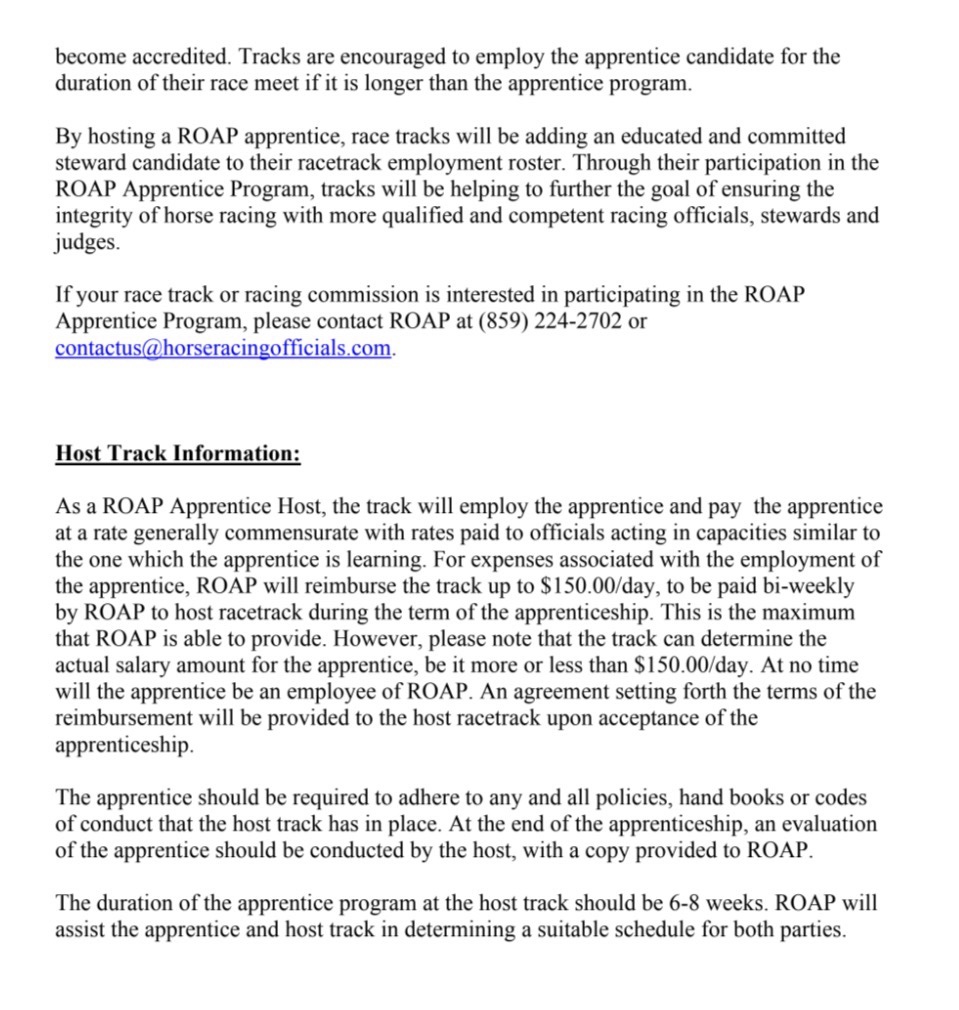
ROAP encourages any individual who has completed the full accreditation school and passed all of the exams (or will pass by the application deadline) to apply for the ROAP Apprenticeship Program. A committee will select one candidate to be placed at a racetrack for approximately 60 days (duration and timing to be determined individually) to receive hands on training in all racing official capacities including but not limited to the stewards or judges stand. A daily stipend will be paid by the racetrack (reimbursed by ROAP) for the apprentice. More information about the program can be found below in the “host track section”.
ROAP Apprenticeship APPLICATION – application requires professional and personal references. It is recommended to review the entire application prior to starting to ensure all components are filled out thoroughly. Thank you
Host Track / Racing Jurisdiction Information:
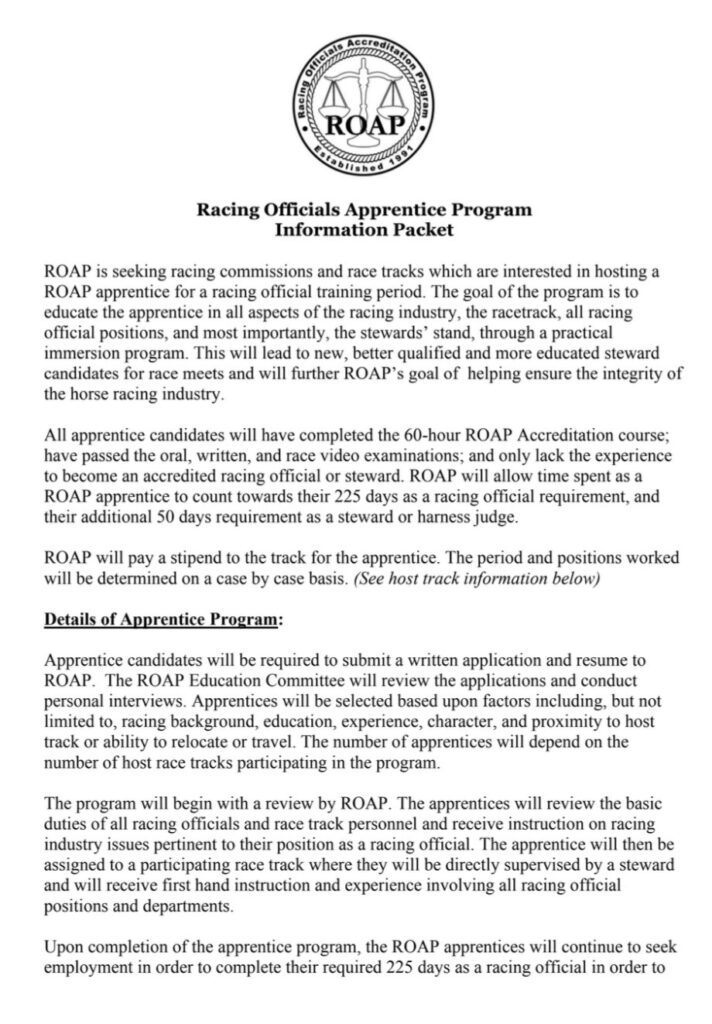
ROAP is seeking racing commissions and race tracks which are interested in hosting a ROAP apprentice for a racing official training period. The goal of the program is to educate the apprentice in all aspects of the racing industry, the race track, all racing official positions, and most importantly, the stewards’ stand through a practical immersion program. This will lead to new, better qualified and more educated steward candidates for race meets and will further ROAP’s goal of helping ensure the integrity of the horse racing industry.
All apprentice candidates will have completed the 60-hour Stewards Accreditation course; have passed the oral, written, and race video examinations; and lack only experience to become an accredited racing official or steward. ROAP will allow time spent as a ROAP apprentice to count towards their 225 days as a racing official requirement, and their additional 50 days requirement as a steward or harness judge.
Racing Officials Apprentice Program Overview
Continuing Education
Requirements
To maintain accreditation, all accredited racing officials, stewards and judges, must attend a continuing education session approved by the Racing Officials Accreditation Program totaling at least 16 credit hours every two years. This can be accomplished by attending one 16 hour session or two 8 hour sessions, as long as 16 credit hours are achieved every two years. The CE year ends on December 31st of a given year.
Please note rolling over excess hours is not permitted.
The CE expiration can only extend to the maximum of 2 years past the current year. For Example: If you attend a CE any time during 2010, your CE expiration can only extend to December 31, 2012.
As of January 1, 2008: In order to maintain accreditation, at least 16 hours of CE must be completed every two years beginning January 1st of the year after the official accreditation date. (Until December 31, 2007, the following timing rule applies: The two-year block of time for the CE requirements starts January 1st after the official accreditation date.)
Types of Continuing Education
As of January 1, 2020: Continuing Education (“CE”) programs may be sponsored by either the University of Louisville Equine Industry Program (“UL”) or University of Arizona Race Track Industry Program (“UA”), or by another group such as a racing commission. Industry conferences for which the content has been pre-approved may also be used to earn CE credit.
The program must be open to all accredited racing officials, stewards, and judges. Any events restricted in attendance to participants from a specific track(s) or jurisdiction(s) are not eligible for regular credits. See restricted course credits below
All tentative and approved CE programs must be posted on the ROAP website.
A tentative CE schedule will be posted at least one year in advance of any prospective CE.
In order to fulfill the CE requirement, the organizer must submit a date, time, location, and tentative agenda at least 90 days prior to the proposed CE for approval by the ROAP Education Committee and shall submit a final agenda within 45 days of the proposed CE for final approval by the ROAP Education Committee. Unforeseen circumstances may be taken into account of late submissions and require special petition from the host.
It is the responsibility of the organizer to provide a certificate of attendance form to all CE attendees, it is the attendees’ responsibility to fill it out and return to the organizer so the records will accurately reflect the attendance at the CE. Undocumented attendance will not count toward fulfillment of the CE requirement.
To be approved for ROAP continuing education, the content of the program must:
-Be designed for either 8 or 16 hours of credit.
-Dedicate no fewer than three hours to the current Points of Emphasis. The delivery method of the POEs is at the discretion of the organizer with the goal of having the content presentation be meaningful and interesting to participants.
-Include a race film analysis/review session as well as an open session, generally referred to as a “roundtable discussion” during which the participants may discuss issues of importance to them.
-Utilize the appropriate number of presenters, given the topics on the agenda, to provide the participants with a broad range of expertise.
Selection of content, beyond what is required, is determined by the organizing party. The content should be timely and of benefit to the participants. Presenting varying perspectives surrounding current issues is always encouraged in an academic (or educational) setting.
Restricted Course Credits: Events with restricted/closed attendance may be eligible for ROAP CE with the stipulation that once the restricted course is taken, the next CE attended must be an open qualifying program. Failure to complete a subsequent open course would revote previously received CE credits. Restricted Course events must still adhere to all other CE host policies as outlined above.
All approved CE’s will then be posted on the ROAP homepage. It is the responsibility of all CE attendees to fill out and return a ROAP Certificate of Attendance to the CE organizer so their records will accurately reflect attendance at the CE. A ROAP Certificate of Attendance so their records will accurately reflect attendance at the CE. Undocumented attendance may not be counted toward fulfillment of the CE requirement.
Online CE: ROAP will conduct at least one sixteen (16) hour online CE per year.
To Re-establish Good Standing
An accredited person who has not attended a CE program in more than two years must: complete the requisite number of 16-hour CE sessions, based on the number of years that have elapsed since the person last attended a CE session OR attend a 60-hour accreditation school.
An accredited person who has not attended a CE session in 10 or more years must: attend a 60-hour accreditation school AND pass all examinations.
Those officials classified as ‘retired’ are still required to make up the requisite CE hours to remaining in good standing.
*Policy updated December 2017 – retired officials re-establishing standing
Points of Emphasis
These Points of Emphasis are subject to the following LEGAL PROVISIONS – Please Read Carefully
The Points of Emphasis
The Points of Emphasis were designed to provide guidelines to follow for coordinating continuing education programs.
2025 Points of Emphasis
BEST PRACTICE
ESSENTIAL STEPS IN AN INQUIRY OR OBJECTION
When an incident occurs that one or more of the stewards feel the incident merits a further review by the board of stewards, that steward should call for the inquiry sign to be posted.
- Post the inquiry sign and flash the numbers or have the inquiry sign posted and the numbers flashed on the tote board.
- Notify the announcer of the inquiry, area of incident (gate, first turn, ¼ pole, etc.) or general inquiry.
Notify mutuels. This step pauses the progression of making the race official.
Notify video field person to note that an inquiry is being conducted to alert other tracks and simulcast facilities.
- Talk to the jockeys/drivers involved and listen on speakerphone. Allow them a chance to tell their side of the story.
This is the time for judges to ask questions and listen, not the time to make statements or give opinions. A ruling may result from the incident and the stewards should avoid any line of perceived prejudice or bias.
- This is also not the time to discuss penalties.
Deliberate, Vote
Be very familiar with the disqualification rule in the state you are currently working. In the event of a placing always vote or call for a vote. Ensure all stewards agree on the new order of finish before releasing the information.
Post information
Once the decision is made, have the order of finish posted on the tote board. Ensure the numbers on the tote board match your decision.
Notify Announcer
Inform announcer of decision and rule violation. It is important the announcer convey to the public that the disqualification was caused by a specific rule violation,
e.g. horse (A) is being disqualified from first to third position for violation of rule number (X) which prohibits or reads in part, a horse crossing over and impeding the progress of another horse causing that horse a chance for a better placing is a violation of this rule.
In the event of a jockey’s/driver’s objection/objections, with or without a Steward’s Inquiry, the specifics (jockey/driver of #——— against #———, etc. for alleged interference at some point in the race) will be clearly expressed to the announcer for public information.
Remind the announcer to always include the statement “to hold all tickets until the race is declared official pending the outcome of the inquiry/objection.”
Inform video department of decision
Inform mutuels and ask if the new order of finish is ready to be posted as official. When there is a new order of finish the mutuel pay-outs have to be recalculated.
Jockey’s/Driver’s Rooms
If there is going to be a film/movie list, advise the jockeys room to post on the board in the jockey’s room listing the race number and jockeys’ names.
Speaking with Jockeys/Drivers
It is critical that all the stewards/judges clearly hear the comments.
All the officials must listen carefully to the jockeys’/drivers’ comments and not be distracted. As you well know, most of the time these comments are fairly predictable and not much help, but occasionally you can learn something that may have been initially overlooked
2023-2024 Points of Emphasis
2023-2024 Points of Emphasis page link here.
2021-2022 Points of Emphasis
Click Here for full descriptions.
- Use and Regulation of the Riding Crop
- Understanding Microchips, Digital Certificates, Track Manager, InCompass and the eTrack System
- Effective Public Speaking and Communication Strategies for Stewards/Judges When Their Role of Trier of Fact (during the hearing process) Changes to That of a Witness Upon Appeal
- Benefits of Working as a Team: the practicing vet/regulatory vet/aftercare trifecta
- Best Practices for Pre-Meet Communications with Licensees
2019 – 2020 Points of Emphasis
Click Here for full descriptions.
- Racehorse Aftercare Awareness
- Interference Rules and Protocols: Consistency in Decisions
- Understanding Microchips and Digital Certificates
- Concussion Protocols and Return to Ride
- Media Training
2017 – 2018 Points of Emphasis
Click Here for full descriptions.
- Crop Issues and Usage of the Riding Crop
- Human Drug Usage: Testing, Prescription Verification, and Contamination Prevention
- Improved Public Perception: Transparency, Consistency, and Decision Making in the Stand
- Resources for Biosecurity: Plans for Reduction of Contamination and Spread of Infectious Disease
- Multiple Medication Violations
- Immigration and Licensing
2016 Points of Emphasis
Click Here for full descriptions of each topic
- Reciprocity of Lists – veterinarian, steward and starter
- Stewards/Judges Code of Conduct
- Encourage Consistency and Uniform Enforcement of Interference Rules
- Enforcement of the Use of the Whip or Racing Crop Rules and Regulations
2015 Points of Emphasis
Click here for full descriptions. Webinar available here.
- Understanding the necessary protocols and procedures to reduce program trainers
- Assessing implementation of industry initiatives at the racetrack
- Understanding licensing protocols and reviews
- Review and understand rule violation penalty determinations
- Understanding and implementation of catastrophic review committees
- Importance of writing, downloading and publishing of steward’s rulings
2014 Points of Emphasis
Click here for full descriptions.
- Encourage the use of technology for RCI database, InCompass, etc by all stewards
- Understanding the application of the National Uniform Medication Program including the Multiple Medication Violation Program and how it affects your jurisdiction
- Ensure clear and concise verbal and written explanations of stewards’ decisions, daily reports and disseminate to the media through track and/or racing regulatory websites
- Encourage consistency and uniformity in enforcement of interference rules
- Understanding Addictive Behavior Treatment Programs available in your jurisdiction
2013 Points of Emphasis
Click here for full descriptions.
- Reciprocity: Lists and Licensees
- Protocols for Declaring a Race as No-contest
- Stewards’/Judges’ Meetings with Racing Officials, Racetrack Staff and Horsemen Prior to Start of the Race Meet
- Protocols for Reciprocity of Suspensions, Summary Suspensions and Restraining Orders
2012 Points of Emphasis
Click here for detailed description
- Reciprocity: Lists and Licensees
- Test Barn and Laboratory – Familiarity with the standard operating procedures and their application to operations.
- Stay up to date on current and new rules, policies and directives in your specific jurisdiction and initiate model rule implementation
- Stable Rosters and Employees – Maintaining current and accurate information and making effective use of the information.
- Racing Office & InCompass – Understanding the racing office procedures and InCompass to provide accurate and timely information for horsemen and the public.
- Media Communication Training – Training and coordination of media communication with commissions and associations.
2011 Points of Emphasis
Click here for detailed description
- Reciprocity of all lists through the use of the InCompass system
- Review track safety rules, procedures and standards with all track management, officials and horsemen and establish track safety committees
- Stay up to date on current and new rules, policies and directives in your specific jurisdiction and initiate model rule implementation
- Enforcement of the use of the whip and/or racing crop rules and regulations in your jurisdiction (including that the racing crop meets the minimum standards and specifications) and if not adopted in your state, advocate for the model rule ARCI-010-035, A(1) and E(7)
- Ensure that clear and concise verbal and written explanations of stewards’ decisions and rulings are given to the media and public especially regarding claims of foul or inquiries including non calls
2010 Points of Emphasis
- Reviewing procedures with all officials at the start of each race meet (May extend to include jockeys/drivers, horsemen, veterinarians, track superintendent, out-riders, EMTs, etc.)
- Stressing routine procedures and mechanics with officials
- Promoting consistency through weekly review by racing officials and riders competing at the track of all racing incidents
- Encouraging maximum participation in ROAP video surveys
- Stressing proper use of the riding crop with jockeys and drivers
- Supervising the enforcement of rules
- Honoring and reciprocating on all lists, including stewards and vets lists
- Taking appropriate measures to resolve licensing issue
2009 Points of Emphasis
- Conduct mock hearings
- Write rulings
- Write daily reports
- Consideration of mitigating and aggravating factors when reaching decisions on penalty phase.
2008 Points of Emphasis
- Uniform handling of objections & inquiries in reviewing the race
- Determining disqualifications in races with multiple incidents of interference
- Stewards & judges should conduct regular meetings with racing officials
- Weekly race video review with jockeys
Continuing Education Standings
Below is a listing and explanation of the ROAP Standings. The ROAP Standing will also coorespond with the ROAP Category Levels.
- Good Standing – fully accredited and has a current CE date (current year or forward)
- Lapsed CE – accredited but CE is not current; participant must make up requisite number of CEs to become current and in good standing
- Needs Experience – has met the educational and examination requirements but lacks the prescribed days of work experience for full accreditation
- Needs to Complete Exams – has one or more outstanding examinations remaining to take
- Awaiting Exam Results – completed school and is awaiting exam results
- EXPIRED – was once accredited but allowed CE to lapse for over 10 years and is now required to ‘start all over’ with the accreditation process. This individual is not accredited.
- Incomplete Requirements — Requirements were not fulfilled in the requisite time period. Individual is now required to ‘start all over’ with the accreditation process. This individual is not accredited.
- ROAP Certificate Recipient – completed a ROAP certificate course for racing officials – this is NOT the same as accreditation. This is a two day course with general overview of the racing office and officials
- Non Applicable – typically those signed up for a class or audited a class/course for their organization and do not have ROAP accreditation and/or is not a ROAP Certificate Recipient